While tradition has often accustomed us to sweet ciders, the trend is shifting toward drier cuvées, revealing new aromas and textures on the palate. To learn more, read our guide on how to choose a good cider .
A word of caution: do not rely on your knowledge of Champagne, it might lead you astray!
As a reminder (or your general knowledge), here is the Champagne scale:
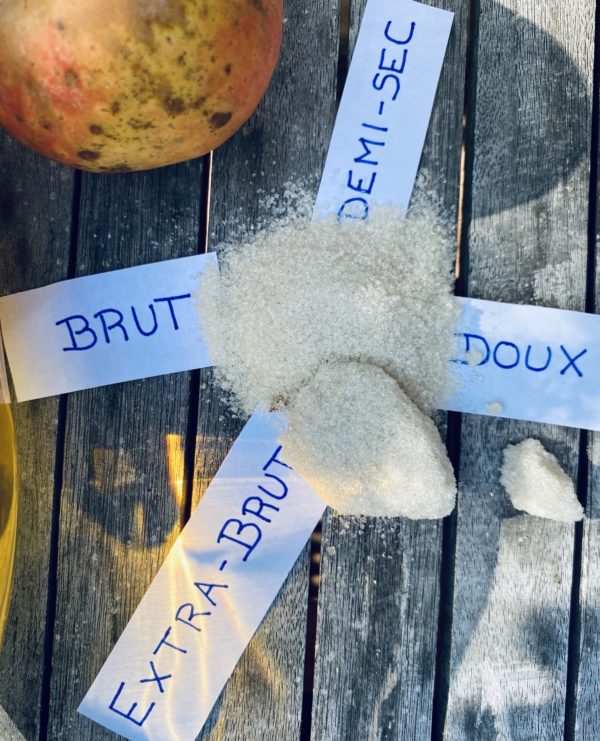
- Champagne Brut Nature: No dosage (added sugar) during production.
- Champagne Extra Brut: Between 0 and 6g of sugar per liter.
- Champagne Brut: Less than 12g of sugar per liter.
- Champagne Extra Dry: Between 12 and 17g of sugar per liter.
- Champagne Dry (Sec): Between 17 and 32g of sugar per liter.
- Champagne Semi-Dry (Demi-Sec): 32 to 50g of sugar per liter.
- Champagne Sweet (Doux): More than 50g of sugar per liter.
Extra Brut
The label “Extra Brut” is appearing more and more on labels, though it is not yet regulated at a national level. Currently, only the AOP Cotentin has standardized this category within its specifications, guaranteeing a residual sugar content of 18 g/L or less and an alcohol content above 5.5% ABV.
Beyond the figures for residual sugar and alcohol, what truly matters is the balance the cider offers during tasting. We invite you to focus more on the harmony of flavors rather than just these labels.
A “Brut” cider could be described as “tart”, “mineral”, “round”, “fruity”, “dry”, “tannic”, or “bitter” … the palette is much broader and far more representative of the diverse profiles found in cider today.
When it comes to pairings, the spectrum is just as vast. This is why we encourage you to try the “impossible”, it is often from these daring choices taht the most stunning pairings are revealed.